PD Industrial homepage
Multi-Site Racking Management: The Case for a Centralised System

Multi-Site Racking Management: The Case for a Centralised System

Published: 19 September 2025By PD Industrial Team

Introduction

Ask the facilities or health and safety director of any multi-site logistics operator to describe their current racking compliance process and you will typically get one of two answers. The first: a confident description of a structured inspection programme with a good contractor, annual reports, and a working repair process. The second - more common than most people admit: a vague reference to inspections being done 'by each site' with reports 'filed somewhere', and a less-than-certain answer about the last inspection date at the smaller locations.

Both situations represent real businesses with real compliance obligations. But only one of them would survive a HSE visit without a serious conversation about improvement. And only one of them could demonstrate - in the event of a racking incident - that its management obligations had been systematically met.

This article examines why multi-site racking management is particularly challenging, what good looks like, and how THEIA - PD Industrial's racking management platform - makes it achievable without the administrative burden that puts most businesses off trying.

Why Multi-Site Racking Management Is Hard

Single-site racking management is already demanding. Add multiple sites, and the complexity multiplies - not just in proportion to the number of sites, but exponentially, because every site introduces new variables: different racking systems, different ages of installation, different contractors with different reporting formats, different inspection dates, and different levels of internal compliance culture.

Fragmented Contractor Relationships

Many multi-site operators have different racking inspection contractors at different sites - often because contracts were set up independently by individual site managers, or because certain contractors only cover certain regions. The result is a fragmented set of contractor relationships, each producing reports in different formats on different schedules, with no central overview.

Paper-Based Reporting

The majority of racking inspection reports in the UK are still produced as PDF documents, emailed to a site contact, and filed - if they're filed at all. There is no systematic process for ensuring that amber-rated findings result in repair instructions, that repair instructions result in completed work, or that completed work is verified before the finding is closed.

In a paper-based system, a red-rated upright can be identified in an inspection report, the report filed by a site administrator, and the red rating never actioned - until the racking collapses.

No Central Visibility

Without a central management system, there is no easy way for a head-office facilities or H&S team to know the current racking health status across the estate. Generating that picture requires contacting every site, chasing reports, and compiling information manually - a process that is time-consuming, error-prone, and typically only happens when someone asks for it, rather than continuously.

What Good Multi-Site Racking Management Looks Like

A well-managed multi-site racking compliance programme has four characteristics.

A Scheduled Inspection Programme for Every Site

Every site has a confirmed annual inspection date, booked in advance, with a reminder process that ensures inspections don't slip. Sites with higher risk profiles - high forklift activity, older racking, previous damage history - are inspected more frequently.

Standardised Reporting

Good multi-site racking management should include inspection reports that follow a standardised format, use the SEMA RAG classification system, and provide photographic evidence of any damage found. This makes it possible to meaningfully compare findings across sites and prioritise remedial action based on risk.

Most inspection reports don't offer this level of consistency. PD Industrial's THEIA does.

A Managed Repair Process

Every amber and red-rated finding from every inspection generates a repair instruction with a defined completion timescale. Repair completion is verified - not assumed - before the finding is closed. Completion is documented with photographic evidence and signed off by a competent person. Again, this is not widely available in the market - however, with PD's repair team, this level of service comes as standard.

A Central Audit Record

At any point, your H&S director or facilities manager should be able to pull a report showing the inspection status of every site, outstanding repair actions, and completed repair history. This record is the evidence of due diligence - and without it, demonstrating that management obligations have been met is extremely difficult.

THEIA - How It Works in Practice

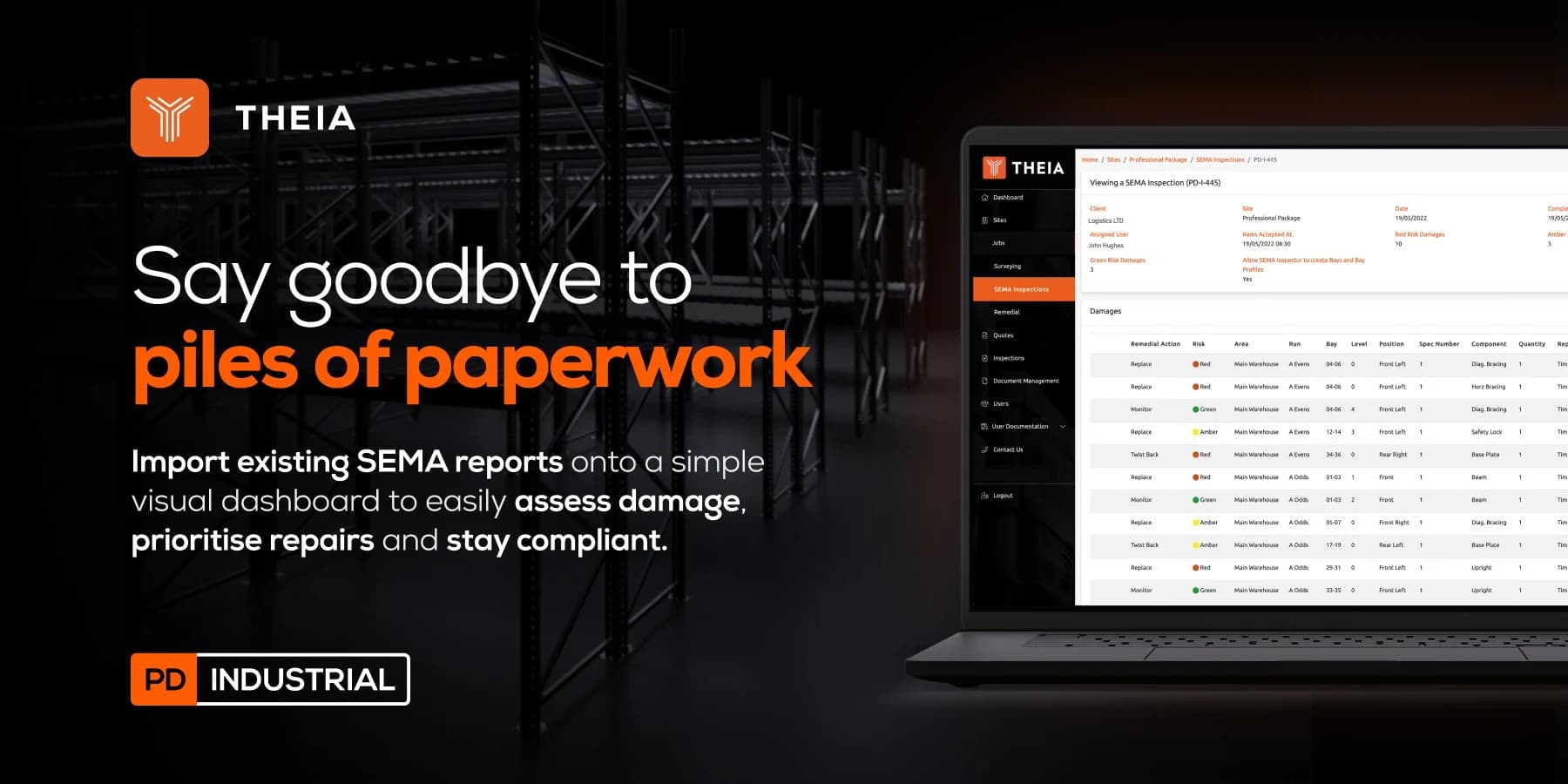
THEIA is the racking management platform that PD Industrial has built specifically to address the challenges of multi-site compliance. Here's what it delivers in practice.

Real-Time Inspection Input

When a PD Industrial inspector visits a site, they log findings directly into THEIA from their mobile device during the inspection - not afterwards. This means that by the time the inspector has finished the walkthrough, the findings are already visible in the central dashboard. There is no 'waiting for the report' - findings are live.

Immediate Visibility of Red and Amber Findings

On completion of your inspection, you immediately receive the report electronically, meaning that when a red or amber finding is logged it can be quickly actioned by the relevant site contacts. Red findings will be accompanied with clear guidance that the affected racking must be taken out of service. This replaces the paper-report-in-an-inbox process with immediate, actionable notification.

Repair Tracking from Instruction to Sign-Off

Every repair generated from a THEIA finding is tracked through the system. The repair instruction is sent to the repair team. Progress is tracked. And critically, the repair cannot be marked as complete in THEIA without a digital sign-off from a named competent person - a step that requires photographic evidence of the completed repair.

This is the feature that makes THEIA genuinely unique in the UK market. No other racking management system requires digital sign-off for repair completion. Every other system relies on someone marking a job as done - THEIA requires them to prove it.

Central Estate Dashboard

The central THEIA dashboard gives an immediate view of the racking health status across the entire site estate with RAG-rated status for each site, outstanding repair actions, overdue inspection and upcoming scheduled inspections. All visible in one place, updated in real time.

Instant Compliance Reporting

For ISO audits, HSE visits, insurer compliance reviews, or board reporting, THEIA generates a complete compliance report for any site or combination of sites with a single click. The report includes inspection history, all findings, repair instructions issued, and repair sign-offs - the complete audit trail.

The Business Case - What Is Non-Compliance Actually Costing You?

The cost of a THEIA subscription and a structured inspection programme is modest relative to the potential cost of the alternative. Consider the financial exposure from a racking-related incident.

Personal injury claims from racking collapses can reach seven figures for serious injuries.

HSE investigation and enforcement costs, including potential prosecution of individuals.

Operational disruption during investigation and remediation - potentially weeks.

Reputational damage with clients, particularly for 3PLs where racking incidents can trigger contract reviews.

Insurance premium increases following an incident.

Against this, the cost of annual SEMA inspections across an estate of ten sites, combined with a THEIA subscription, represents a small fraction of the potential liability exposure. The business case for a centralised compliance programme is not difficult to make - the challenge is usually inertia, and the complexity of getting started.

PD Industrial makes getting started straightforward. Our team surveys your estate, sets up THEIA to reflect your site structure, and implements an inspection programme that gives you immediate visibility from day one. Contact us to discuss your multi-site racking estate.

Related Articles

Request a callback